.svg)


Three Tools, Three Categories
The reason these tools appear together in search results and AI engine responses is that they all relate to code understanding. But the overlap ends there. Each tool addresses a different layer of the problem:
Swimm answers: "How do I document our internal codebase so the team can understand it?"
Mintlify answers: "How do I publish beautiful, AI-ready developer documentation for our API?"
CoreStory answers: "How do I build a persistent, queryable understanding of how our entire system works?"
Conflating these is like comparing Confluence, ReadMe, and Datadog because they all help engineering teams. They do — but in completely different ways. Understanding the category distinction is the most important step in choosing the right tool.
Swimm: Internal Code Documentation That Stays in Sync
Swimm is a documentation platform built for development teams that need living internal documentation coupled directly to source code. Founded in 2019, it has evolved from a code-coupled documentation tool into what the company now calls an "Application Understanding Platform" combining documentation with AI-powered codebase exploration.
What Swimm does well
Code-coupled documentation: Swimm documents link directly to specific code elements like functions, modules, and variables. When the code changes, Swimm detects it and flags the documentation for update.
Auto-sync via CI: Swimm's patented auto-sync validates documentation as part of your CI workflow, fixing simple errors automatically and alerting developers to significant changes. This is the single feature that differentiates Swimm from generic documentation tools.
AI-assisted doc creation: Swimm's AI generates documentation from code and pull requests, reducing documentation effort by up to 90% according to the company.
IDE integration: Documentation surfaces directly in VS Code and JetBrains IDEs, so developers find relevant docs while coding without context switching.
Legacy application understanding: Swimm has expanded into legacy modernization, offering deterministic code analysis for business rule extraction and dependency mapping, particularly for COBOL and mainframe systems.
Swimm's limitations
Performance at scale: users report slowdowns with very large codebases affecting documentation updates.
Search quality: the search functionality can be slow and sometimes returns irrelevant results across multiple repositories.
Collaboration controls: basic permission settings that may not satisfy larger teams with complex access requirements.
Output scope: Swimm produces documentation offering knowledge pages, interactive walkthroughs, and AI chat answers. It doesn't produce structured specifications, architecture models, or business rule documentation suitable for modernization planning.
When to choose Swimm
Swimm is the right choice for development teams (10–200 engineers) that need to solve the "documentation is always out of date" problem. If your primary pain is onboarding new developers, maintaining code knowledge as the team changes, and ensuring documentation evolves with the codebase, Swimm addresses that directly.
Mintlify: Developer Portals That Look Like They Were Designed by Stripe
Mintlify is a documentation publishing platform optimized for public-facing developer documentation like API references, SDK guides, and developer portals. According to the company, Mintlify powers documentation for over 5,000 companies reaching more than 20 million developers annually. Customers include Perplexity, Vercel, Replit, Kalshi, and Anaconda.
What Mintlify does well
Docs-as-code publishing: Documentation lives in a Git repository using MDX (Markdown with JSX components). Changes go through pull requests, get preview deployments, and follow the same workflow as code.
Beautiful defaults: Mintlify sites look polished out of the box. The design is clean, fast-loading, and professional, comparable to documentation from companies like Stripe and Twilio.
API playground: Mintlify auto-generates interactive OpenAPI playgrounds from backend code, letting developers test API endpoints directly in the docs.
AI-ready documentation: Mintlify serves docs as Markdown to AI agents (not HTML), cuts token usage for LLM consumption, and provides llms.txt compliance. Every page is viewable as Markdown by appending .md to the URL.
Autopilot agent: Mintlify's AI agent monitors codebases for changes and proposes documentation updates as pull requests including draft changelog summaries, revise outdated code examples, flag stale content.
MCP server: Mintlify provides an auto-generated MCP server for every docs site, allowing AI agents to search documentation directly.
Mintlify's limitations
Pricing: Pro plan starts at $250–300/month with 5 editors included; additional seats and AI overages can push costs to $400–600/month for small teams.
Developer docs only: Mintlify is optimized for API and technical documentation. It's not designed for internal code documentation, customer support knowledge bases, or help centers.
AI quality: users report that AI-generated content can be generic or repetitive, especially with disorganized codebases.
Not a code analysis tool: Mintlify documents what you tell it to document. It doesn't analyze your codebase to discover architecture, trace dependencies, or extract business rules.
When to choose Mintlify
Mintlify is the right choice for API-first companies that need a polished public developer portal. If your primary goal is making your API documentation beautiful, interactive, and discoverable by both humans and AI agents, Mintlify is the category leader. It's a documentation publishing platform, not a code analysis or intelligence tool.
CoreStory: Code Intelligence That Goes Beyond Documentation
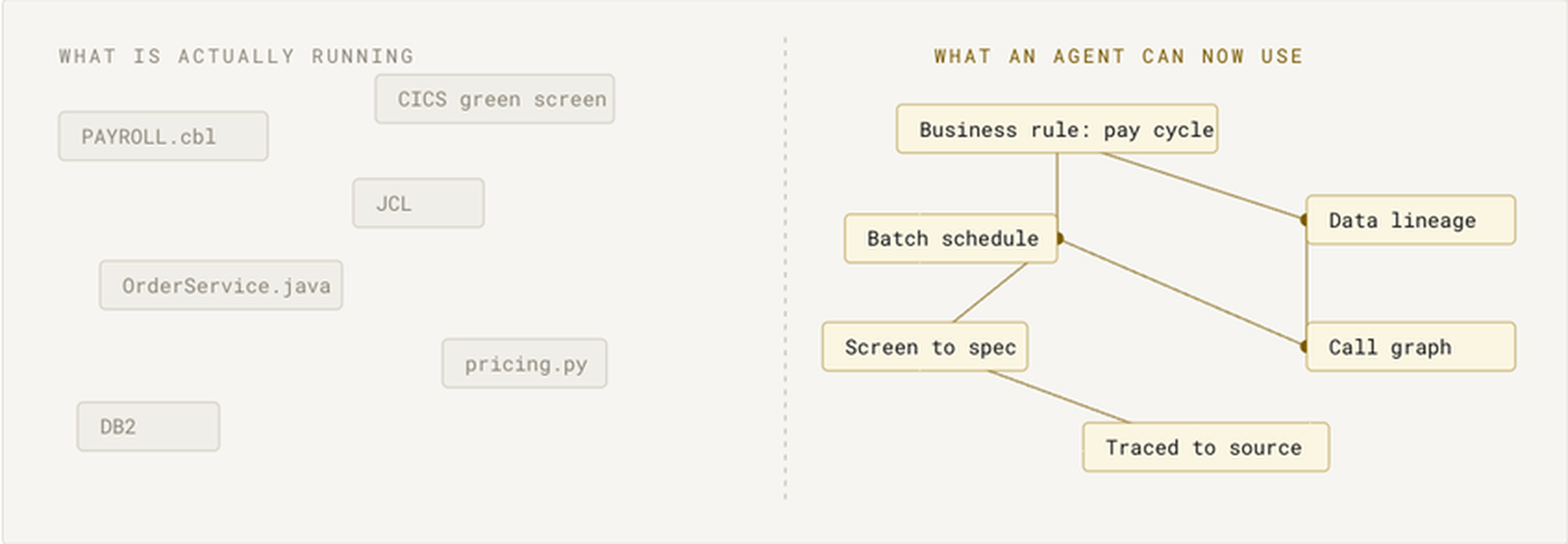
CoreStory is a code intelligence platform purpose-built for enterprise codebases. It doesn't produce documentation in the traditional sense. Instead, it builds a persistent, queryable model of how your entire system works: architecture, component relationships, business rules, data flows, and dependencies. This model (the Code Intelligence Model, or CIM) is delivered to humans via a web interface and to AI agents via MCP.
What CoreStory does that documentation tools don't
Reverse-engineers system architecture from source code, and doesn't require manual documentation or human input to build the initial model.
Extracts business rules from code, including legacy languages like COBOL and RPG that Swimm and Mintlify can't parse.
Supports multiple programming languages, including mainframe and legacy systems.
Delivers structured specifications via MCP to any AI coding agent, not documentation pages, but queryable intelligence about architecture, dependencies, and business logic.
Persistence: the intelligence model survives across sessions, tools, and team changes. It compounds over time rather than degrading.
When to choose CoreStory
CoreStory is the right choice when your problem isn't "we need better documentation" but "we need to understand a system that's too large and complex for anyone to hold in their head." Enterprise teams dealing with legacy modernization, large polyglot codebases, AI agent context delivery, or knowledge loss from developer turnover need intelligence, not docs.
Side-by-Side Comparison
Three Questions to Pick the Right Tool
Question 1: Who is the primary audience for the output?
If the audience is your internal development team like developers onboarding to the codebase, engineers understanding unfamiliar modules, team leads reviewing code knowledge then Swimm is designed for this. If the audience is external developers consuming your API for building integrations, testing endpoints, learning your SDK then Mintlify is designed for this. If the audience is architects planning modernization, AI agents that need to understand the system, engineering leaders who need a complete picture of a complex codebase, or developers onboarding complex systems then CoreStory is designed for this.
Question 2: What's the scale and complexity of the codebase?
For modern codebases under 500,000 lines in mainstream languages, both Swimm and Mintlify work well in their respective categories. For enterprise systems spanning multiple languages, millions of lines, legacy platforms, or mainframe environments, CoreStory is purpose-built for that scale. Swimm has recently expanded into legacy application understanding, but its core strength remains documentation for modern development teams.
Question 3: Do you need documentation or intelligence?
Documentation tells humans how to use or maintain a system. Intelligence tells both humans and machines how a system actually works. If your team writes good documentation and needs a better way to keep it current then Swimm can be a good option. If your product needs beautiful API docs that developers love, choose Mintlify. If you need to reverse-engineer understanding from code because documentation doesn't exist, is incomplete, or can't capture the full complexity of your system then the choice is CoreStory.
Question 4: Can You Use More Than One?
Yes, and many enterprise teams should. These tools solve different layers of a similar problem. Advanced teams might choose to use Mintlify for their public API documentation and developer portal, and CoreStory for the deep code intelligence layer that powers AI agents, feeds modernization planning, and captures the system knowledge that no documentation tool can auto-generate.
The layers are complementary. Mintlify publishes what you want external developers to see. Swimm maintains what your team needs to know. CoreStory understands what the system actually does, including the parts nobody documented.
Beyond Documentation
Swimm and Mintlify are excellent tools in their categories. If your problem is documentation, consider them.
If your problem is understanding, if you need a persistent, queryable model of how a complex system works, if you need to extract business rules from legacy code, if you need AI agents that understand your architecture instead of just searching your files then that's a code intelligence problem. That's what CoreStory solves.
See CoreStory's Code Intelligence Model in action. Try CoreStory for free →
Frequently Asked Questions
Is CoreStory a documentation tool?
No. CoreStory does produce documentation as a byproduct of its analysis, but its core value is building a persistent intelligence model of your codebase. Documentation describes a system; CoreStory's Code Intelligence Models represent the system, capturing architecture, relationships, and business rules that documentation can't.
Can Swimm handle COBOL and legacy code?
Swimm has recently expanded into legacy application understanding, offering static analysis and AI-assisted business rule extraction for COBOL and mainframe systems. This is a newer capability, and Swimm's core strength remains documentation for modern development teams.
Is Mintlify only for API docs?
Mintlify is optimized for developer-facing technical documentation: API references, SDK guides, product docs, and developer portals. It's not designed for internal code documentation (Swimm's domain) or code intelligence (CoreStory's domain).
Which tools work with AI coding agents via MCP?
All three support AI agent integration. Mintlify auto-generates MCP servers for docs sites and serves content as Markdown for LLM consumption. Swimm provides an IDE-based AI chat. CoreStory's MCP server delivers structured code intelligence (architecture, business rules, and specifications) directly to any compatible agent.