.svg)


The Token Bill Nobody Talks About
A 10-engineer team running Claude Code against a 500,000-token codebase can burn $15,000–$40,000 per month in context re-ingestion alone before writing a single line of net-new logic. That's not a projection. That's what happens when AI agents are given raw code instead of structured intelligence.
Here's the math. Each developer session re-sends the same modules, schemas, and helper functions the model saw yesterday. A single prompt involving a non-trivial subsystem easily runs 20,000–50,000 input tokens. Multiply by 10 engineers, 20 working days, and 3–5 sessions per day, and you're looking at a substantial monthly token bill just for context, before accounting for the model's output.
Output tokens compound the problem. Most AI providers charge 3–5x more for output tokens than input tokens. When the model lacks proper context, it produces longer, more hedged responses and requires more correction rounds. Each round re-ingests the context, generates more output, and adds to the bill. The real cost of poor context isn't just the tokens you send, it's the tokens you generate trying to fix the results.
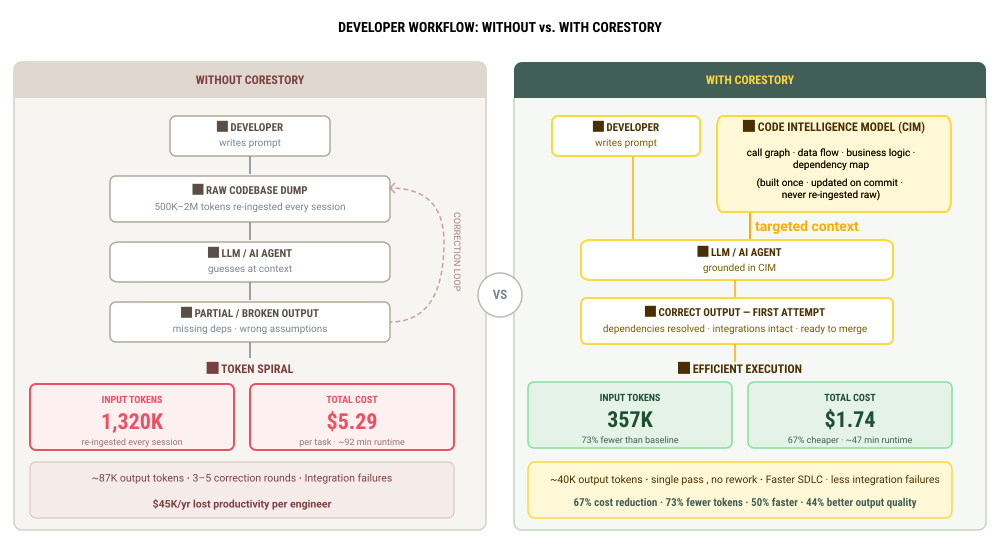
In a real customer evaluation: Claude Code + CoreStory MCP used 73% fewer input tokens, ran in half the time, and cost 67% less with better output quality.
Table 1: Real-world cost comparison for adding a complex feature to a large enterprise codebase
Why LLMs Have a Context Problem With Large Codebases
LLMs don't retain memory between sessions. Every interaction starts from zero. When a developer asks an AI agent to refactor a module, the model needs not just that file, it needs the schemas it depends on, the helper functions it calls, the data flow it participates in, and enough architectural context to avoid introducing regressions. That's tens of thousands of tokens per request, for context the model already processed yesterday.
This creates a pattern of escalating repeated spending. Teams working on production systems often send 1.5–5 million tokens per month simply to keep the model oriented before counting any of the actual work tokens. And this is the base model cost. Many AI coding agents (Devin, Factory, and others built on top of foundation models) charge a premium per token and burn more per session through agentic loops.
It's important to note that coding agents like Claude Code do support persistent configuration files (like CLAUDE.md, skill files and custom instructions) that carry context across sessions and can be shared across a team. But there's a meaningful difference between agent configuration ("here's how to work on this codebase") and code intelligence ("here are the critical architectures, business rules, and interdependencies, pre-mapped and queryable"). The former tells the agent how to behave. The latter gives it something to actually know. Configuration files are also rarely centrally governed, they drift, they vary by developer, and they don't scale with codebase complexity.
Why Agentic Loops Are Especially Expensive
A standard developer prompt re-ingests context once. An AI agent running a multi-step loop — plan, execute, reflect, error-correct, retry — re-ingests that context at every step. A 10-step agentic loop on raw code isn't 10x the token cost of a single prompt. It can be 30–50x, because each reflection and error-correction cycle starts with a full context re-ingestion.
This is where the CoreStory ROI is most dramatic. Providing an agent with a structured Code Intelligence Model instead of raw files doesn't just reduce the initial context, it reduces every downstream step, every correction round, and every output generation in the loop.
What a Code Intelligence Model Actually Is (And Why RAG Doesn't Solve This)
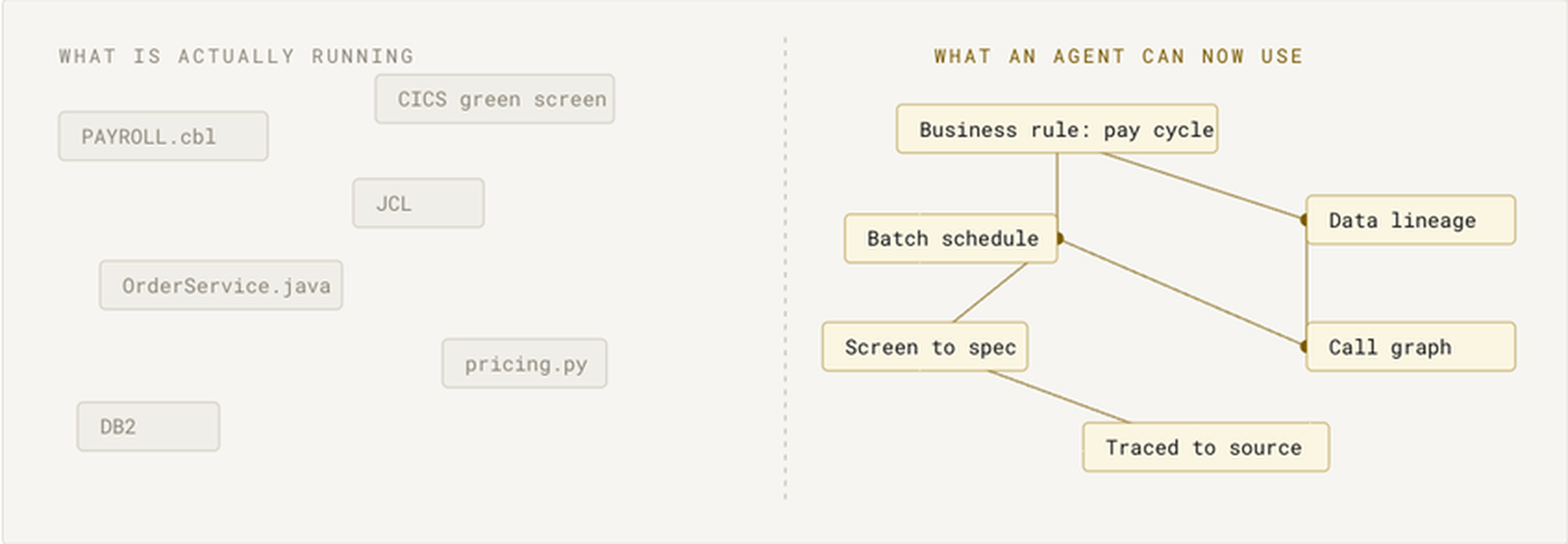
CoreStory ingests your entire codebase once and produces a Code Intelligence Model, a hierarchical specification organized by domain, module, and behavior contract. CoreStory's pipeline performs static analysis, call graph extraction, data flow tracing, and business logic summarization to produce structured output that captures what the software does, not just what it says.
This is meaningfully different from a flat embedding index or a retrieval-augmented generation (RAG) approach. RAG sounds appealing: chunk the codebase, embed it, retrieve relevant chunks at query time. In practice, it fails for code in four specific ways:
- Poor chunking boundaries: code modules don't chunk cleanly at semantic boundaries. A stored procedure and the schema it depends on rarely land in the same chunk
- Loss of cross-module dependencies: chunked embeddings lose the call graph, which is exactly what the model needs to avoid introducing integration errors
- No business logic layer: RAG retrieves code text; it doesn't extract the invariants, edge cases, and behavior contracts the CIM explicitly captures
- No invariant preservation: the CIM maintains consistent structural relationships; retrieval results vary by query phrasing, producing non-deterministic behavior in agentic loops
The result of using a CIM instead of raw code or RAG: the model receives a concise, high-signal specification rather than thousands of tokens of implementation detail , which is why token consumption drops by 70%+ in practice.
The Quality Multiplier: Better Context Means Fewer Corrections
According to the 2025 Stack Overflow Developer Survey (65,000+ respondents), 87% of developers are concerned about AI accuracy, and 45% say debugging AI-generated code is more time-consuming than debugging their own.
That 45% statistic sounds abstract until you connect it to payroll. A developer at $150,000 fully-loaded annual cost spending 30% more time debugging AI output is losing approximately $45,000 per year in productivity (before you count the rework tokens the model burns trying to correct its own mistakes).
Microsoft co-research with CoreStory found a 51% accuracy improvement when AI agents operate from CoreStory specifications rather than raw code. Across AI coding agent benchmarks, teams using CoreStory to supercharge AI coding agents see 44% better results.
The mechanism is straightforward: a model with a complete, consistent architectural view produces code that integrates correctly on the first attempt. It doesn't need to infer dependencies, they're specified. It doesn't need to guess at business rules, they're documented. Fewer hallucinations, fewer integration failures, fewer correction rounds. And fewer correction rounds means fewer output tokens, which compounds the cost savings.
Total Savings Across Team Sizes
The figures below use Claude Sonnet 4.6 API pricing ($3/M input, $15/M output) as the enterprise baseline. Token estimates are based on observed developer usage patterns for teams using Claude Code as a primary development tool.
Table 2: Token savings by developers team size
The 10-engineer range ($15K–$40K/month) reflects our own observed data on context re-ingestion costs for teams working on 500,000+ token codebases, before net-new output is factored in.
Token savings are clear, but they’re still only one side of the equation.
Let’s consider a fully-loaded senior developer at $200,000/year — salary, benefits, overhead. That's roughly $100/hour, or about $16,700/month. Across a 10-engineer team, developer cost runs to ~$2M/year before infrastructure, tooling, or management costs.
From the Stack Overflow Developer Survey, 45% of developers say debugging AI-generated code takes longer than debugging their own. Our evaluation data shows that with CoreStory, AI agents produce correct output on the first attempt more often. That's fewer correction rounds, fewer rework cycles, less time spent debugging hallucinated integrations:
1. Task execution time — 50% reduction
Our real-world evaluation measured a 49% reduction in execution time for a complex feature task. Applied conservatively, a developer spending 6 hours/day on AI-assisted development tasks effectively recovers 3 hours — or gains the equivalent of one additional developer-day every two days.
2. Rework reduction from better output quality
Fewer hallucinations, fewer integration failures, fewer correction rounds. If 30% of developer time currently goes to debugging and reworking AI-generated code (consistent with the Stack Overflow data), a 50% reduction in that rework reclaims 15% of total developer capacity.
Table 3: The Full Savings Combined
*Developer time value recovered assumes 50% of working hours are AI-assisted tasks, and a 50% speed improvement on those tasks — applied to a $200K fully-loaded cost.
**Rework reduction assumes 30% of time currently lost to debugging/correcting AI output, with 50% of that recovered through higher-quality first-pass output.
Beyond Cost: Speed and SDLC Quality
Token savings are the most measurable benefit, but the compounding effect on the overall software development lifecycle may be more significant. When AI agents have complete architectural context from the start:
- Onboarding time for new developers drops: they can query the CIM instead of reading source code for weeks
- Code review cycles shorten: reviewers can verify that generated code matches specified behavior, not just syntax
- Integration failures decrease: the CIM's explicit dependency map means fewer surprises when merging
- Documentation stays current: the CIM is regenerated from source, so it reflects the actual codebase, not the last time someone updated the wiki
In the customer evaluation referenced in Table 1, execution time was cut in half not just because of fewer tokens, but because the model needed fewer iteration cycles to produce correct output. The first attempt was closer to the right answer, which meant less back-and-forth, less rework, and a faster path from task to merged code.
The Bigger Picture: Context Windows Grow. Codebases Grow Faster.
Every LLM release announcement leads with a larger context window. The implicit promise is that this solves the context problem: just fit more code in the prompt. It doesn't.
Context windows are growing at roughly 4x per generation. Enterprise codebases grow at roughly 10–20% per year, but more importantly, the codebases that need AI assistance most are the ones that have been growing for 20–30 years. A 2-million-token context window doesn't fit a 30-year-old insurance platform's stored procedures, metadata-driven configuration, and undocumented integration layers.
As context windows grow but codebases grow faster, and as agentic loops multiply token consumption non-linearly, the gap between what an LLM can hold and what a production system contains will widen, not close. The teams that treat codebase understanding as a managed artifact, not an ad-hoc prompt input, will compound their AI investment advantages over time.
CoreStory is the missing piece: the persistent, queryable Code Intelligence Model that gives AI agents what they actually need — not more tokens, but better ones.
Want to see CoreStory's token impact on your codebase? Talk to an engineer who can model your specific usage pattern — corestory.ai/talk-to-an-expert.
Frequently Asked Questions
Does CoreStory work with my existing AI coding tools?
Yes. CoreStory integrates with Claude Code, GitHub Copilot, Cursor, Devin, and other AI coding agents via MCP server integration and CoreStory Playbooks. The CIM is available as structured context that any AI agent can query.
Is the 70% token reduction typical?
The 73% input token reduction shown in Table 1 represents a specific task (adding a complex feature to a large codebase). Reductions vary by task type, codebase size, and the proportion of context the task requires. Tasks requiring narrow, well-specified context see the largest reductions; tasks requiring broad exploration may see less. The consistent finding across evaluations is that quality improves regardless of context reduction.
What programming languages does CoreStory support?
CoreStory supports a long list of languages including Java, C#, Python, COBOL, PowerBuilder, and SystemVerilog just to name a few.