.svg)


Your Agents Are Capable. They're Just Flying Blind.
There's a growing gap between what AI coding agents can do in theory and what they actually deliver in practice. Claude Code, Cursor, Copilot, Devin, Codex, Droid — every major agent has gotten dramatically more capable over the past year. They can plan multi-step tasks, edit across files, run tests, and iterate on their own output.
And yet, engineering teams keep reporting the same experience: the agent works on small tasks, stumbles on anything that crosses system boundaries, and burns tokens exploring dead ends it could have avoided with five minutes of architectural context.
The problem isn't the agent. It's the context.
Context engineering has emerged as one of the most important disciplines in AI-assisted development. Thoughtworks, Anthropic, and individual practitioners have all converged on the same insight: curating what the model sees is the single highest-leverage thing you can do to improve output quality. As Anthropic's own engineering team put it, effective context engineering means finding the smallest possible set of high-signal tokens that maximize the likelihood of the desired outcome.
But there's a meaningful difference between configuring an agent (writing a CLAUDE.md file, setting up rules, defining skills) and actually giving it deep, structured knowledge about the system it's working in. Configuration tells the agent how to behave. Knowledge gives it something to reason about.
Agent Boosting is the practice of closing that gap: equipping your coding agents with persistent, structured code intelligence so they perform at their actual capability ceiling rather than stumbling through unfamiliar code.
Two Sessions, Same Agent, Different Outcomes
To understand what Agent Boosting changes, consider two versions of the same task.
Without Agent Boosting: A developer asks their coding agent to fix a bug where inherited attributes are missing their docstrings in a Sphinx documentation build. The agent reads the relevant files, identifies the docstring retrieval logic, and patches it. The fix is locally coherent — it looks correct based on the code the agent can see. Tests fail. The agent iterates, adjusting the retrieval logic, adding edge case handling, exploring adjacent files. After 20 minutes and thousands of tokens, the developer intervenes and discovers the actual root cause: attributes were never collected during member enumeration, an upstream problem in a completely different function. The agent was fixing the right symptom in the wrong place.
With Agent Boosting: The same developer, same agent, same task. But before the agent starts exploring code, it queries CoreStory's intelligence model via MCP. CoreStory serves two roles in this interaction. First, it acts as an Oracle — answering questions about how the Sphinx documentation pipeline is intended to work, what the data flow looks like, and what invariants govern member enumeration. Then it acts as a Navigator — pointing the agent to the specific function where attributes are collected, the method signatures involved, and the extension points that downstream retrieval depends on.
The agent sees immediately that the collection stage is the problem, not retrieval. It targets the upstream function, writes the fix, and passes tests on the first implementation.
This isn't a hypothetical. It's sphinx-8548 from CoreStory's SWE-bench evaluation, where three independent agents — Claude Code, Droid, and Codex — all converged on the same wrong fix at baseline, and all three solved the task correctly when given architectural context. When agents with different architectures and different underlying models all make the same mistake and all correct course from the same context, the failure isn't model-specific. It's a structural gap that better context closes.
Why Agents Fail on Complex Tasks
Every AI coding agent, regardless of architecture or underlying model, shares the same fundamental constraint: it reasons from what's in its context window. When that context is raw source code, the agent has to infer architecture from implementation details, guess at dependencies it can't see, and reconstruct system boundaries that were never documented.
This works fine for small, self-contained tasks. It breaks down predictably on anything that requires understanding how components relate to each other.
In a controlled evaluation CoreStory ran across six leading agents on the 45 hardest tasks in SWE-bench Verified, the failure pattern was consistent. Agents didn't fail because they couldn't write correct code. They failed because they pursued the wrong solution path — fixing symptoms instead of causes, missing hidden dependencies, or patching one location in a multi-file bug and leaving the others untouched.
The dominant failure mode, accounting for 72% of all task flips from fail to pass, was wrong solution prevention: agents pursuing locally rational but architecturally incorrect approaches because they couldn't see pipeline boundaries. The second most common, at 46%, was hidden dependency discovery — implicit coupling between components that's invisible from local code inspection. In one Django task, two independent agents discovered through CoreStory that a transform class internally constructs a completely different lookup class, a dependency with no visible trace in the source file (the full taxonomy of five failure modes is covered in our benchmark deep dive.)
These aren't edge cases. Over half the tasks in the evaluation — 24 of 45 — contained at least one problem that an agent could only solve with better context.
What Agent Boosting Actually Looks Like
Agent Boosting isn't a feature. It's a workflow discipline built on three principles.
1. Oracle before Navigator. Understanding before location.
The typical agent workflow is: receive task, explore code, form a plan, implement. Agent Boosting restructures this into two distinct phases before the agent writes any code.
First, the agent queries CoreStory as an Oracle: How is this system intended to work? What are the invariants? What are the business rules? What's the data flow through this pipeline? This is context synthesized from the entire codebase — not just file contents, but the meaning behind them. The Oracle captures architecture, behavior contracts, design history, and edge cases that aren't visible in any single source file.
Then the agent queries CoreStory as a Navigator: Which files do I need to change? What methods are involved? Where are the extension points? What are the call sites? Instead of grep-wandering through hundreds of files, the agent gets directed to exactly the code it needs.
This Oracle-before-Navigator pattern is the single most important practice in Agent Boosting. It prevents the agent from diving into code changes before understanding the system's constraints. In CoreStory's benchmark evaluation, this pattern improved success rates by an average of 25% across all six agents tested. The highest uplift was 44% (Claude Code), and even the strongest baseline agents (Droid and Devin, already at 80%+ success) improved by 14%. Research published jointly with Microsoft found a 51% accuracy improvement when AI agents operate from CoreStory's structured specifications rather than raw code.
2. Make context persistent and queryable, not session-scoped.
Most context engineering today is session-scoped. You write a CLAUDE.md or a .cursorrules file, maybe set up some MCP servers, and the agent gets that context at the start of each session. This is a meaningful improvement over nothing, but it doesn't scale. Recent research from ETH Zurich found that LLM-generated context files actually degraded agent performance by 3% compared to no context file at all, while human-written files provided only a marginal 4% improvement. The researchers found that agents given more context often ran more steps and incurred higher costs without producing better patches, because the context wasn't structured for how agents actually consume information.
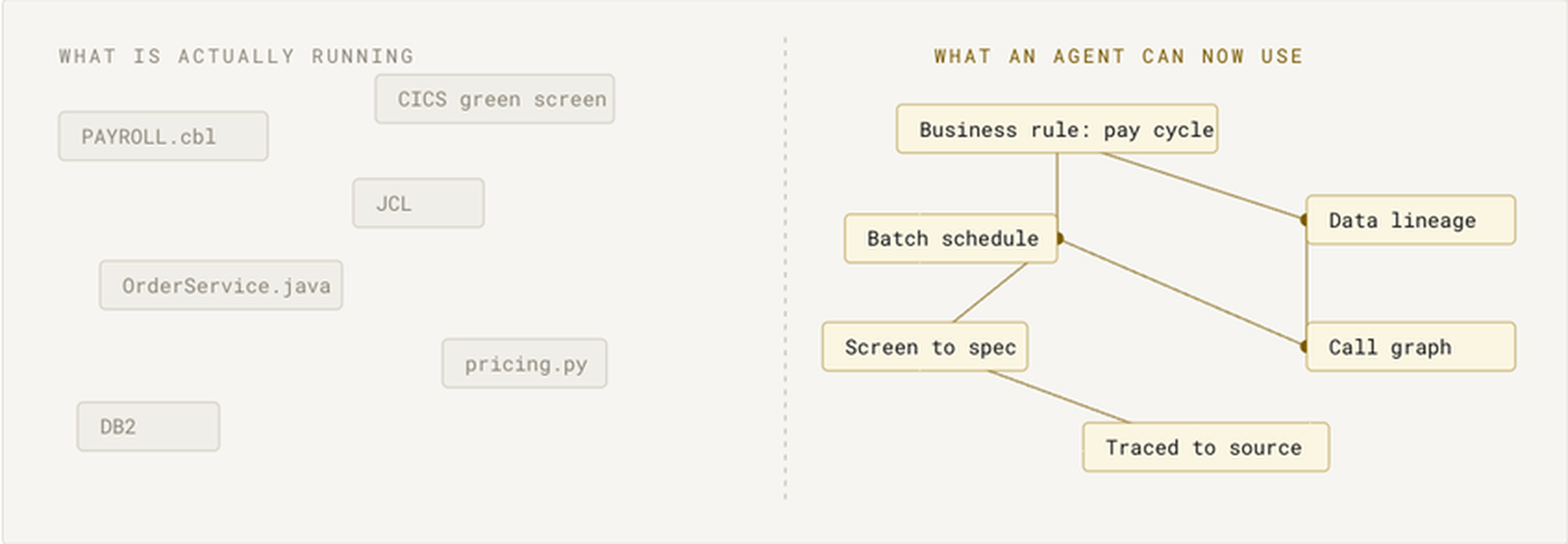
Agent Boosting requires a persistent intelligence layer that goes deeper than markdown files. CoreStory's Code Intelligence Model performs static analysis, call graph extraction, data flow tracing, and business logic summarization to produce structured output that captures what the software does, not just what it says. That intelligence persists across sessions, across developers, and across agents — and it's derived directly from the codebase, so it stays current as code evolves rather than drifting like manually written documentation. Conversations with the intelligence model persist too, accumulating institutional knowledge that future queries in the same thread benefit from.
3. Eliminate cross-session re-ingestion.
Every time an agent starts a new session against the same codebase, it re-reads the same files, re-infers the same architecture, and re-discovers the same dependencies. That's wasted tokens and wasted time on every single session.
Agent Boosting replaces this pattern with targeted Oracle and Navigator queries against persistent intelligence. Instead of the agent reading 300 files to orient itself, it asks: What are the dependencies of this module? What's the data flow through this pipeline? Where are all the call sites for this function? The answer comes back in hundreds of tokens instead of hundreds of thousands. CoreStory's cost evaluation measured this directly: Claude Code augmented with CoreStory used 73% fewer input tokens per task. Across the benchmark evaluation, agents avoided reading an estimated 300-500 files in aggregate across all flipped tasks, replacing exploratory code archaeology with targeted architectural queries.
The Economics: Why Agentic Loops Change the Math
The cost case for Agent Boosting starts with an insight most teams haven't internalized yet: agentic loops don't scale linearly. A standard developer prompt re-ingests context once. An AI agent running a multi-step loop — plan, execute, reflect, error-correct, retry — re-ingests that context at every step. A 10-step agentic loop on raw code isn't 10x the token cost of a single prompt. It can be 30-50x, because each reflection and error-correction cycle starts with a full context re-ingestion. And when the model lacks proper context, it produces longer, more hedged responses and requires more correction rounds — each of which generates output tokens that most providers charge 3-5x more for than input tokens.
This is where Agent Boosting delivers its most dramatic ROI. Reducing context at the input doesn't just save on the first step. It compounds savings across every downstream step, every correction round, and every output generation in the loop.
CoreStory's real-world cost evaluation measured the impact on a complex feature task against a large enterprise codebase:
At team scale, the numbers compound. A 10-engineer team running agents against a 500,000-token codebase can spend $15,000 to $40,000 per month on context re-ingestion alone. CoreStory's conservative modeling — applying a 50% token reduction to AI-assisted work hours and factoring in recovered developer time from higher first-pass accuracy — yields $740K to $890K in annual savings for a 10-engineer team. At the 50-engineer scale, the number approaches $3.7M to $4.5M annually.
The developer time recovery isn't speculative. The 2025 Stack Overflow Developer Survey (65,000+ respondents) found that 45% of developers say debugging AI-generated code takes longer than debugging their own. Enterprises using CoreStory report up to a 50% reduction in human development time by replacing manual discovery, documentation, and validation with automated specifications. Better first-pass accuracy reduces debugging overhead directly.
Agent Boosting Across the Development Lifecycle
Agent Boosting isn't limited to bug fixes. The Oracle-before-Navigator pattern applies across the full development workflow, because every task benefits from the agent understanding the system before modifying it.
Bug resolution. The agent queries CoreStory to understand how the system should work, generates root cause hypotheses grounded in actual architecture, writes a failing test, and implements a minimal fix. This is the workflow behind the SWE-bench results above (Playbook).
Feature implementation. The agent uses CoreStory to understand existing patterns, data structures, and integration points before writing new code. Instead of inventing a new approach, it extends the system in a way that's consistent with established conventions (Playbook)
Spec-driven development. CoreStory provides the architectural truth that standalone specification tools can't — ensuring specs describe changes constrained by what the system actually does today, not what someone remembers it doing. The agent writes architecture-grounded specifications before implementation, then implements against them (Playbook).
Test generation. The agent derives comprehensive test suites from CoreStory specifications: positive cases, negative cases, edge cases, error contracts, and idempotency tests. Coverage is driven by business rules, not just code paths (Playbook).
Technical due diligence. In M&A scenarios, CoreStory enables rapid architectural analysis of acquisition targets: understanding architecture, identifying risks, assessing technical debt, and evaluating integration complexity — without needing the target's engineering team to walk you through it (Playbook).
Each of these workflows follows the same core pattern. The agent first consults CoreStory for understanding, then for location, then acts on what it learned. The specifics change. The discipline doesn't.
Where Agent Boosting Fits in the Context Engineering Stack
Context engineering is becoming a layered discipline. As Thoughtworks observed, all forms of AI coding context engineering ultimately involve markdown files with prompts, but those files serve fundamentally different purposes depending on what layer they operate at. Here's how Agent Boosting relates to the practices most teams already have in place.
Configuration files (CLAUDE.md, .cursorrules, agent skills) tell the agent how to behave in your codebase: coding standards, testing conventions, preferred libraries. These are table stakes. But as ETH Zurich's research showed, even well-written config files provide only marginal accuracy gains while often increasing agent step count and cost.
MCP servers and tool access give the agent the ability to query external systems, run commands, and interact with services. These expand what the agent can do.
Agent Boosting via persistent code intelligence gives the agent structured knowledge about the system itself: architecture, data flow, dependencies, business rules, semantic intent. This determines whether the agent makes the right decisions with its expanded capabilities. CoreStory's Code Intelligence Model is meaningfully different from a flat embedding index or RAG approach — it captures cross-module dependencies, behavior contracts, and business logic that chunked embeddings lose.
The three layers are complementary. Configuration without knowledge produces agents that follow your style guide but still misunderstand your architecture. Knowledge without configuration produces agents that understand the system but don't follow your conventions. You need both.
Getting Started with Agent Boosting
If you're already using AI coding agents, the fastest path to Agent Boosting is connecting your codebase to CoreStory's intelligence layer. CoreStory integrates with Claude Code, Cursor, GitHub Copilot, Devin, Codex, and Droid via MCP — no changes to the agents themselves. Setup takes minutes: generate an MCP token in the CoreStory dashboard, add the server URL to your agent's configuration, and verify by asking the agent to list your projects.
If you're evaluating agents, consider testing with and without structured architectural context. CoreStory's benchmark data shows that the agent you choose matters less than the context you give it. A mid-tier agent with good context routinely outperforms a top-tier agent flying blind. In the SWE-bench evaluation, Cursor augmented with CoreStory (51% success) outperformed baseline Codex (64% baseline, but without CoreStory's architectural guidance on the hardest failure modes).
If you're managing costs, start by measuring your team's token re-ingestion rate: how many tokens per session are spent re-sending context the model already processed in a prior session? That number is your addressable waste. CoreStory customers have reduced it by 50-73%.
Whichever path you start from, adopt the Oracle-before-Navigator discipline immediately. Before your agent touches code, ask it to query for understanding first: How does this pipeline work? What are the invariants? What's the intended behavior? Then ask for location: Which files implement this? Where are the extension points?
The quality of what the agent builds depends on the specificity of what you ask. "Tell me about the order system" produces vague context. "What is the validation logic for order placement, what fields are required, and how is stock validation handled?" produces the kind of context that prevents wrong solutions.
The agents are good enough. The question is whether you're giving them what they need to show it.
Ready to boost your coding agents? Try CoreStory free or talk to an expert to model the impact on your codebase.
Further Reading
- Supercharging AI Agents with CoreStory — setup guide, supported agents, workflow playbooks, and best practices
- Deep Dive: How CoreStory Improves Benchmark Performance for Coding Agents — full benchmark methodology and failure mode taxonomy
- How CoreStory Cuts LLM Costs by 70% While Improving Output Quality — token economics, team-scale cost modeling, and the agentic loop multiplier
- CoreStory Raises $32M Series A — Microsoft co-research, enterprise customer outcomes, investor thesis
- Effective Context Engineering for AI Agents (Anthropic) — foundational context engineering principles
- Context Engineering for Coding Agents (ThoughtWorks) — practitioner's guide to the emerging context engineering discipline