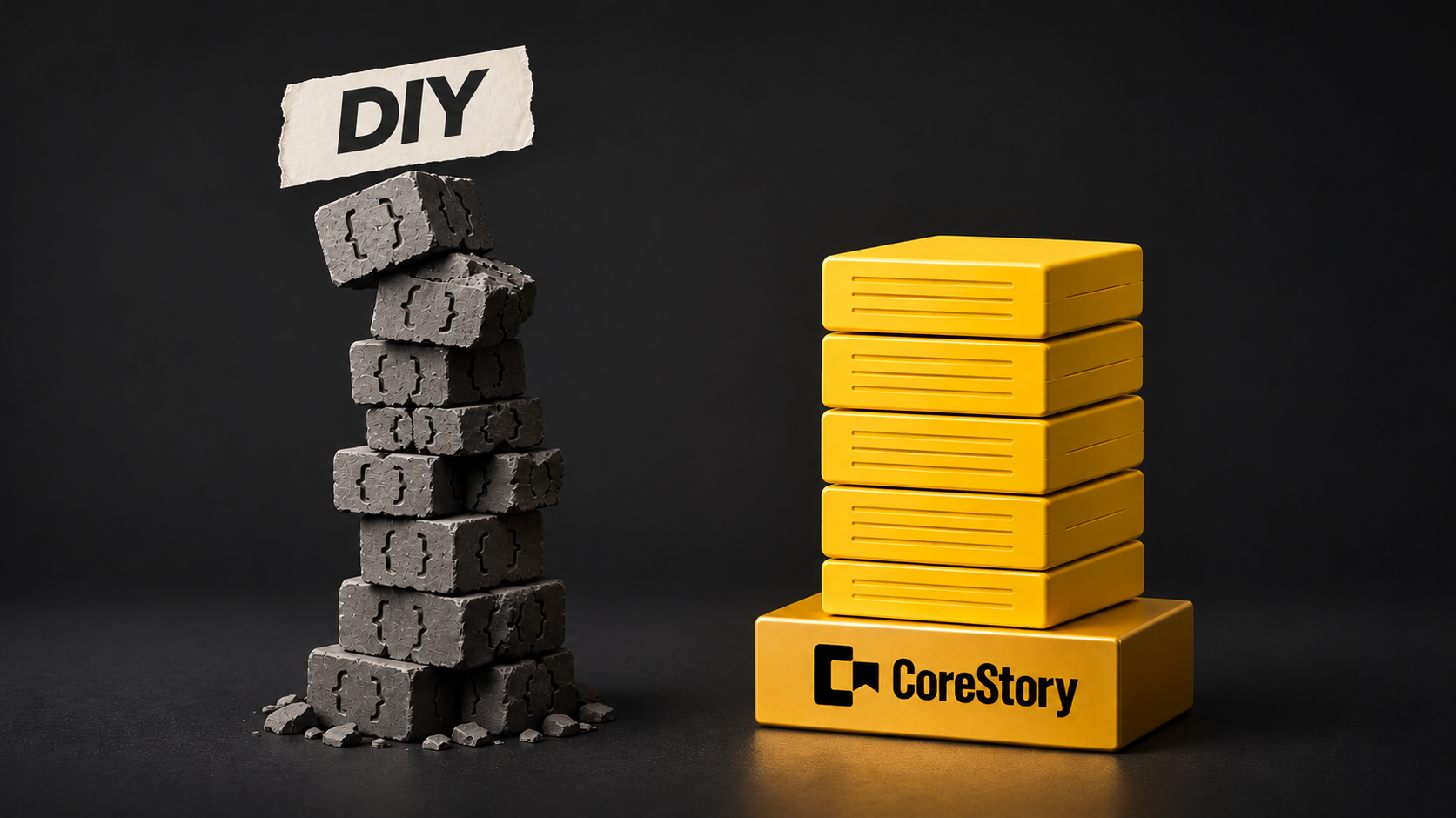
TL;DR Most enterprise teams already own AI coding tools, and many try to fix those tools' blind spots on legacy code by building their own context layer. Rules files, retrieval over the repository, homegrown code graphs, and custom agent harnesses all help on smaller systems. They tend to break down across millions of lines, many repositories, and business rules that span systems, and they turn engineers into maintainers of an internal platform. This guide compares the DIY approaches with CoreStory and lists the questions to answer before you build.
The conversation usually starts the same way. A team has rolled out GitHub Copilot, Claude Code, or Cursor, and the tools work well on newer services. On the core systems, though, the agents make changes that compile and still break something downstream. Someone on the platform team says, reasonably, that the agents just need better context and that the team could build a context layer itself.
That instinct is sound, because context really is the problem. Anthropic's engineering team describes context for AI agents as "a finite resource with diminishing marginal returns" (source). The real question is whether your team should own the system that supplies that context. This post compares the common DIY approaches with CoreStory so you can make that call with clear eyes.
Why teams build their own context layer
Building in-house is a rational first move, and the same reasons come up consistently in our customer conversations.
- The team has strong engineers who already know the codebase and the AI tools.
- The company has already paid for Copilot, Claude Code, or Cursor licenses and wants them to deliver.
- Security teams prefer that code and the knowledge derived from it stay inside the company.
- An early prototype on one repository looks promising.
None of these reasons are wrong. The trouble shows up later, when the prototype meets the full codebase.
The four most common DIY approaches
1. Rules and instruction files
Teams write files such as AGENTS.md, Copilot instructions, or Cursor rules that tell agents about conventions, build steps, and important modules. AGENTS.md has become a common open format for this, and tools including OpenAI Codex and Cursor support it (source).
These files work well for conventions, commands, and guardrails in a single repository. They are written by hand, so they cover only what someone remembered to write down, and they drift as the code changes. They cannot hold the business rules of a large system.
2. Retrieval over the repository
Teams index their code into a vector store and retrieve the most similar chunks for each request. This helps agents find relevant files in a codebase that one team can still hold in its head.
Similar text is not the same as related behavior, however. Retrieval returns snippets, not the chain of calls, batch jobs, and data flows that decide what a change will affect.
3. A homegrown code graph
More advanced teams parse their code into a graph of modules, calls, and dependencies so agents can ask what depends on what. This answers structural questions well inside the languages the team wrote parsers for.
Every additional language, framework, and integration needs its own parsing work, and the graph knows structure without knowing meaning. It can tell you which services call a function. It cannot tell you which eligibility rule that function enforces.
4. A custom agent harness
Some teams build a harness that orchestrates agents, feeds them instructions and retrieved context, and adds checks around their output. This standardizes how agents run inside one team.
Over time the harness becomes a product of its own. It needs owners, upgrades for every new model and agent, and constant tuning, and the platform engineers who build it are pulled away from the systems they were hired to modernize.
Where DIY context layers break down at enterprise scale
The four approaches share the same limits once they meet a large legacy codebase.
- Scale is the first limit. A prototype on one repository rarely survives hundreds of repositories, several languages, and decades of history.
- Freshness is the second. Hand-built context starts to drift the day it is written. Teams tell us their documentation is accurate on day one and out of date by the end of the week.
- Business meaning is the hardest part. The knowledge that matters most is not in any single file. It lives in business rules spread across several systems and in the downstream impact of changing them.
- Cost adds up quietly. Agents that rediscover the system on every task spend tokens and time re-reading code they already read yesterday.
- Consistency suffers. When each tool and team builds its own context, Copilot, Claude Code, and Cursor give different answers about the same system.
- Ownership never ends. The context layer becomes an internal platform that someone has to staff, secure, and maintain indefinitely.
DIY context layer vs. CoreStory at a glance
| Criteria | DIY context layer | CoreStory |
|---|---|---|
| Coverage | Usually the repositories and languages the team prioritized first | Entire codebases, legacy and modern, across repositories |
| What it captures | Conventions, retrieved snippets, or structural links | Architecture, workflows, dependencies, business rules, and specs |
| Freshness | Updated when someone remembers to update it | A persistent intelligence model that updates automatically as the code changes |
| Shared across tools | Often rebuilt for each tool or team | One model served to Claude Code, GitHub Copilot, Cursor, Devin, and any other agent that supports MCP |
| Who can use it | Mainly the developers who built it | Developers, architects, analysts, and AI agents |
| Ownership | Your engineers build and maintain it | CoreStory maintains the platform, and your engineers focus on your systems |
How CoreStory approaches the context layer
CoreStory is built to be the context layer that enterprise teams keep trying to build. It ingests an entire codebase and builds a persistent intelligence model of how the system works, including its architecture, dependencies, workflows, and the business rules buried in the code. The model updates automatically as the code changes, so agents work from the system as it is today.
People explore that model and review generated specs in the CoreStory web interface. AI coding agents query the same model through CoreStory's MCP server and API, so Copilot, Claude Code, and Cursor all work from one shared understanding of the system. CoreStory publishes playbooks that walk through connecting each agent.
Because the model persists, understanding compounds instead of being rebuilt for every task.
CoreStory does not replace your AI coding tools. It helps the tools you already pay for work on the systems where they struggle today.
When building your own still makes sense
DIY is the right call in some situations, and it is worth being honest about them.
- Your codebase is small or modern enough that agents can read most of what they need directly.
- You only need conventions and guardrails, which a well-maintained AGENTS.md file handles well.
- Context engineering is part of the product you sell, so owning it is a strategic investment.
Many teams combine both approaches. They keep rules files for team conventions and connect their agents to CoreStory for system-level understanding.
Questions to answer before you build
- How many repositories, languages, and integrations does the context layer need to cover in its first year?
- Who will keep it current as the code changes, and how will you know when it is wrong?
- Will it capture business rules in language that analysts and auditors can review?
- Will every AI tool your teams use get the same answers from it?
- How many engineers will own it next year, and what would they build instead?
If the answers point to a long-lived internal platform, compare that cost with a context layer you can connect today. Talk to an expert about giving your AI coding tools a persistent understanding of your codebase.
Frequently asked questions
What is a context layer for AI coding agents?
A context layer is a shared source of structured knowledge about a codebase that AI coding agents query while they plan and write code. It supplies the architecture, dependencies, and business rules that agents cannot see in the files they have open.
Can GitHub Copilot or Claude Code index our repository on their own?
They can retrieve code from a repository, which helps on smaller systems. On large legacy codebases, retrieved snippets miss the relationships and business rules that span files, services, and repositories. A context layer supplies that system-level understanding to every tool.
Is an AGENTS.md file enough context for AI coding agents?
For conventions, build steps, and guardrails in one repository, it often is. It is written by hand, so it cannot capture the business rules of a large system or stay current as that system changes.
Does CoreStory replace our AI coding tools?
No. CoreStory connects through MCP to the tools you already use, including Claude Code, GitHub Copilot, Cursor, Devin, and any other agent that supports MCP. It gives them a persistent model of your codebase to query.