.svg)


Understanding Code at Scale: A Conversation with Anand Kulkarni on the Future of Code Intelligence
How spec-driven development is transforming enterprise software
Introduction
"Language models are great at understanding small amounts of code, they quickly lose context when trying to understand how to carry out complicated activities."
This is the fundamental problem facing every enterprise trying to leverage AI for software development. While LLMs excel at greenfield projects and simple tasks, they struggle with the real world—the millions of lines of legacy code, the complex interdependencies, and the nuanced engineering decisions that define enterprise systems.
In this conversation, Anand Kulkarni, CEO and founder of CoreStory, explains how code intelligence is solving this challenge and why the future of software development isn't about writing code faster—it's about understanding systems deeply enough to make the right decisions.
The Context Window Crisis
Enterprise codebases have outgrown AI's ability to understand them. The problem is simple but profound: even today's best foundation models tap out at around 200,000 to a million tokens—roughly 50,000 to 100,000 lines of code. Most enterprise systems are far larger.
"If you've tried working with any of the popular coding agents on a substantive software system, they can do really low level simple tasks somewhat effectively," Anand explains. "But they struggle when they come to carrying out real complicated tasks that we might want a human being to carry out."
The challenge isn't just size. Enterprise codebases come with:
- Spaghetti code with complex interdependencies
- Black boxes spanning multiple languages outside LLM training sets
- Platform-specific requirements that require deep system understanding
- Undocumented behaviors that exist only in tribal knowledge
Traditional coding agents try to work around this with code search and indices. It's not enough.
Code Intelligence: A New Category
This is where code intelligence diverges from coding agents and code analysis tools. Anand frames it through an organizational analogy:
"Think about the relationship between a product manager, a business analyst, and a human software developer inside a human organization. Software agents are great at generating software from small specifications and well-defined instructions. They often require some kind of deeper understanding of an existing software platform or clearer instructions about what to carry out."
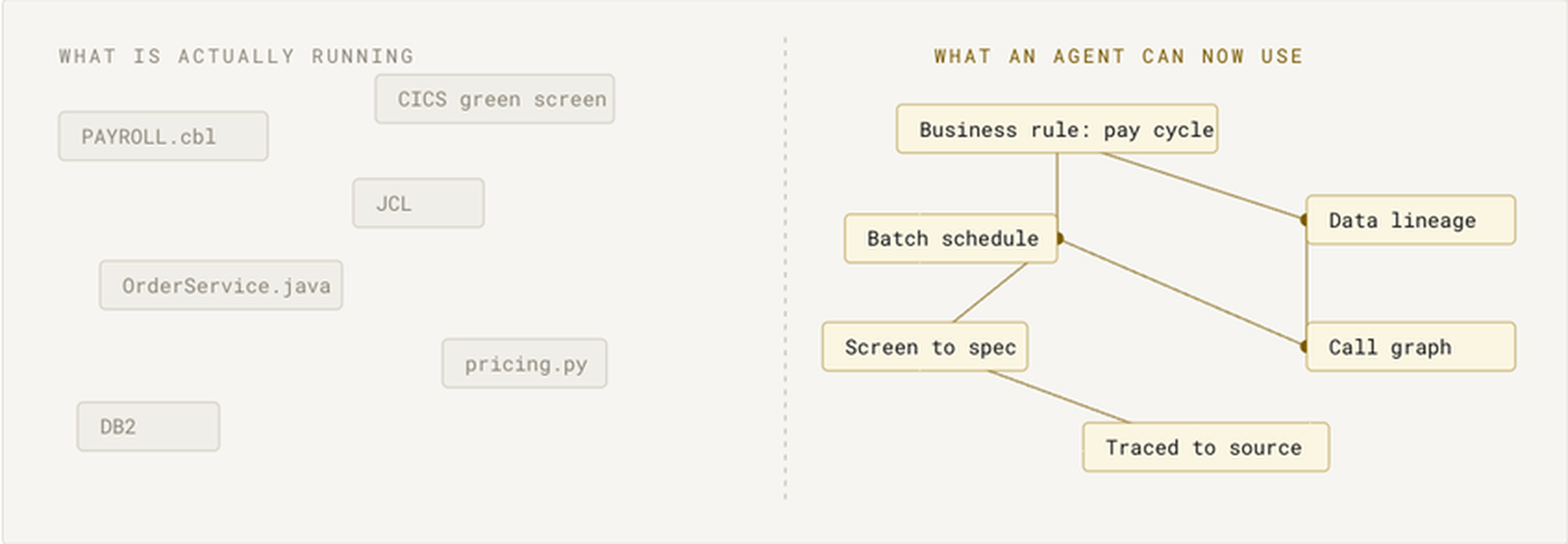
Code intelligence models like CoreStory provide that understanding. They reverse-engineer large enterprise codebases back into requirements and specifications, creating what Anand calls an "intelligence model"—essentially an atlas for AI agents to consult when navigating a codebase.
The difference is tangible. While coding agents rely on search and code indices, CoreStory's intelligence model can:
- Understand actual functionality in relation to human language
- Map business logic to customer feature requests
- Answer questions about how to implement specific tasks
- Generate accurate pull requests by consulting the existing spec
"This isn't theoretical," Anand notes. "We've shown this both with our own performance on major software engineering benchmarks like SWE-bench, and with customers who see meaningful increases in their sprint velocities."
Real Impact: 200%+ Velocity Gains
The results speak for themselves. Teams implementing spec-driven development with CoreStory are seeing velocity boosts of 200% or better.
One example: CoreStory partnered with NTT Data to support a massive enterprise COBOL application running on mainframe—over 11 million lines of code handling huge volumes of daily production transactions. Historically maintained by teams of humans painstakingly making changes and hoping nothing broke.
With CoreStory's intelligence model, NTT Data saw a 2x gain in their ability to deliver tickets. The system could now understand existing code, field incoming tickets, and make changes with confidence.
But the gains aren't just about speed. They're about transformation:
- Senior engineers freed from maintenance work to focus on innovation and R&D
- Development backlogs cleared as AI agents handle routine tasks
- Onboarding measured in days, not months as new developers get instant context
- Legacy code shifts from cost center to opportunity space
As Anand puts it: "Building gets fun again."
Spec-Driven Development: The New Paradigm
Here's the conceptual shift that defines CoreStory's approach: in the AI era, the specification becomes the source of truth—not the code.
"Coding agents can generate more code at a cost that is almost zero," Anand explains. "Therefore, the most important piece that we can control is that spec. The code itself is something of an ephemeral artifact."
This is spec-driven development (SDD). Instead of treating code as the permanent asset, organizations maintain a complete, accurate, living specification that describes how their software behaves. AI agents generate code from that spec on demand.
The implications are profound:
For legacy modernization: No more choosing between expensive maintenance and risky re-platforming. With a complete spec generated by CoreStory, companies can:
- AI maintenance - Dramatically reduce IT budget by having agents maintain existing systems
- Selective migration - Move pieces to new frameworks with high confidence and low risk
- Spec as permanent truth - Transform the spec into any language or framework on demand
"This might be the last modernization project that a CIO needs to run," Anand suggests. "Once your system has a fully up-to-date spec that is kept current as the system changes continuously, you can treat that spec as the source of truth and transform it using your favorite coding agent into whatever language or system you need at a given moment."
For governance and reliability: Spec-driven development means complete test coverage derived from the spec, agents consulting that spec for daily updates, and organizations maintaining the spec as a living document attached to the codebase.
Beyond Modernization: Unexpected Use Cases
While legacy modernization draws the most attention, CoreStory is solving problems across the enterprise:
1. Private Equity Due Diligence
PE firms need to understand inherited code quickly during M&A cycles—security deficits, behavioral gaps, whether the value proposition matches reality. Historically, this meant expensive consultants on short notice.
Now PE teams use CoreStory to analyze acquisitions rapidly, asking intelligent questions about security posture, IP risks, redundancies, and cost efficiencies. They can verify what was reported during the M&A process with confidence.
2. Deep Behavioral Analysis
Some customers use popular coding agents like GitHub Copilot and Cursor but struggle to understand specific behavioral patterns in their code that these agents miss. CoreStory's intelligence model succeeds because it describes code behaviors beyond line-by-line interactions.
3. Agent Boosting
Perhaps the most interesting use case: customers come to CoreStory saying, "We made a big investment in Copilot or Claude or Codex. We love these tools, we believe in the vision. They're just not at the level of a smart intern yet. We need to figure out how we can make them perform like a senior engineer."
The answer? Give them a spec. Let them talk to CoreStory's intelligence model. Watch the performance transform.
"Consistently those customers see that each of those coding agents is able to carry out more complicated tasks more efficiently, save tokens, and deliver better results while doing so," Anand confirms.
Getting Started: It's Simpler Than You Think
Integration with CoreStory involves just two steps:
- Ingest your codebase into CoreStory to create an intelligence model
- Turn on the MCP server integration to let your coding agents talk to CoreStory
That's it. Teams see velocity gains almost immediately.
The harder part? Getting the human organization to adapt.
"AI is not a replacement for human beings in your organization," Anand emphasizes. "It is a shift in what those human beings are going to do, and that shift takes some work."
Developers move from writing code for every ticket to supervising teams of agents. The responsibility shifts from execution to oversight, from coding to problem-solving.
Anand's advice for CTOs exploring AI-assisted development:
- Set realistic expectations - AI isn't magic. Success requires iteration, feedback cycles, and refinement over days or weeks.
- Follow spec-driven best practices:
- Use an intelligence model, not just a coding agent
- Ensure every application has an attached spec
- Establish practices for keeping that spec continuously up to date
- Embrace the transformation - This shift makes building fun again. The velocity gains are real if you do it right.
What's Next for CoreStory
Following our Series A announcement, CoreStory is rolling out exciting partnerships with major coding agents and releasing new self-serve flows that make adoption easier for teams inside your organizations.
"We're excited to reach out to more and more developers who are able to make use of CoreStory with their favorite coding agents to carry out development in a better way," Anand shares.
The Bottom Line
The future of software development isn't about replacing developers with AI. It's about transforming what developers do—from writing code to solving problems, from coordinating humans to enabling agents, from maintaining legacy systems to understanding and evolving them.
Code intelligence makes this transformation possible. By treating specifications as the source of truth and code as an ephemeral artifact, enterprises can finally escape the maintain-versus-modernize trap that has defined software engineering for decades.
The question isn't whether your organization will adopt spec-driven development. It's when—and whether you'll lead the change or follow it.
Try CoreStory Free
Ready to experience 200%+ velocity gains in your own engineering organization?
CoreStory offers a free tier that lets you:
- Ingest and analyze your codebase to create an intelligence model
- Integrate with your favorite coding agents (Claude Code, GitHub Copilot, Cursor, and more)
- Start seeing velocity improvements immediately
- Clear development backlogs and free your senior engineers for innovation
Watch the Full Conversation
This post is based on a conversation with Anand Kulkarni, CEO and founder of CoreStory, recorded in January 2026. The full 30-minute interview covers:
- Why LLMs struggle with enterprise codebases
- The difference between coding agents and code intelligence
- How spec-driven development works in practice
- Real customer stories from NTT Data and private equity firms
- Practical advice for CTOs implementing AI-assisted development
CoreStory is pioneering the Code Intelligence Movement—transforming how development teams understand, navigate, and evolve complex software systems. By making specifications the source of truth, CoreStory enables AI agents to work effectively on the massive, complex enterprise systems that define modern software engineering. Learn more at corestory.ai.