TL;DR Every enterprise system has a story made up of the business rules it enforces and the reasons it was built the way it was, but only a few people can usually read it. AI coding agents can't read it either, so on legacy systems they break rules that no ticket mentions and teams end up supervising them line by line. CoreStory V3 reads that story and gives it to every engineer, analyst and agent, with each rule traced to the exact lines of code that enforce it. In our launch benchmark, frontier agents working from CoreStory V3 fixed or flagged an unstated rule in 40% to 74% of attempts on hard tickets, compared with 4% to 36% working alone. You can download V3 and start using it for free on your own code today.
Every system on which your business runs has a story. It explains where each business rule lives, how one change can affect batch jobs in other systems, and why nobody wants to touch a certain file. For decades, only the few people who could read the code knew that story. Everyone else has had to work around it, including the AI coding agents that enterprises now rely on.
That is the gap CoreStory V3 was built to close. Today we are launching CoreStory V3, a new version of our platform that turns large and legacy codebases into a knowledge graph of how each system works, including its business rules and the exact lines of code that enforce them. V3 gives that story to every engineer, analyst and AI agent, so changes are done right the first time. We are showing V3 at our booth at Microsoft Ignite in San Francisco this week, and anyone can download it and start for free.
Why V3 matters
AI coding agents keep getting more capable, even on languages like COBOL. However, reading the code is not the same as knowing the rules it enforces. The foundational systems that power large enterprises contain millions of lines of COBOL, RPG, PowerBuilder and .NET, with scant documentation and few people left who know how they work. On those systems, agents miss business rules or invent ones that do not exist, and teams spend their time checking the agents' work.
Agents keep taking on bigger tasks, but they still make subtle mistakes of scope and understanding that keep them from working unsupervised. Those mistakes rarely show up on the public benchmarks that labs and agent makers use to compare themselves, because those benchmarks aren’t built around the unwritten rules embedded within the implementation of enterprise systems. That leaves most enterprises stuck in an expensive middle ground where agents are fast enough to be useful but not reliable enough to work unsupervised. Our founder and CEO Anand Kulkarni describes it as the difference between a group of software engineering agents operating at 20% autonomy and a software factory running at 95%. CoreStory V3 is built to help teams get there.
When agents and engineers work from the full story of a system, four things change:
- Fewer broken rules reach production, because agents get the relevant business rules while they plan and edit, and they flag any change that conflicts with one.
- Reviewers spend less time supervising agents, because a flagged conflict names the exact rule and the exact place to look.
- Knowledge stays in the organization as experts leave and agents change, because the rules that lived in a few people's heads now become a shared map that stays with the codebase and serves every later task and agent.
- The AI tools you already own deliver more, because CoreStory works with Claude Code, GitHub Copilot, Cursor, Codex and any other agent that supports MCP.
How CoreStory V3 reads the story in your code
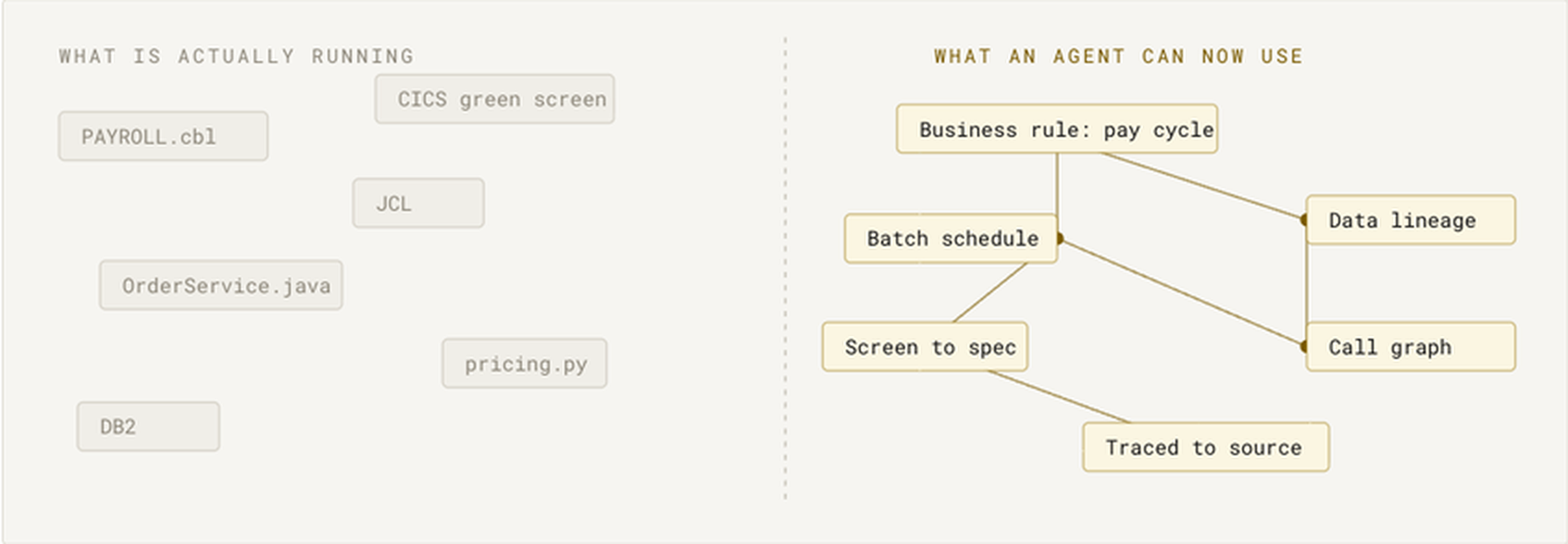
CoreStory is not a coding agent but the knowledge layer from which your coding agents work. CoreStory V3 reverse-engineers a group of applications into a knowledge graph of how they work, including their architecture, data models, workflows, and business rules. The graph is far more than code loaded into a search index, because it records how each system is structured, how it behaves and the business intent behind it. CoreStory also reads database schemas, which often shape how a legacy system works. It normalizes every finding into the language your business uses and links it to the source it came from.
What is new in CoreStory V3
- V3 extracts every business rule it finds and ties each one to the exact lines of code that enforce it.
- V3 automatically hands a coding agent the specific rules that affect its change while it plans and edits, so the agent doesn't have to search for them.
- Where an agent supports hooks, V3 runs edit-time checks that flag a change that conflicts with a known rule before it ships.
What the benchmarks show
We are publishing the V3 Launch Benchmarks alongside this release. They test the same frontier models with and without CoreStory V3, and each model is compared only with itself.
We gave agents 14 hard tickets, each of which depends on a business rule the ticket never mentions. With CoreStory V3, they fixed or flagged that rule in 40% to 74% of tries, compared with 4% to 36% on their own. We chose these tickets because agents working alone fail them, which means the gains show up where the risk is highest.
| Model | Hard tickets fixed or flagged (alone → with CoreStory V3) | Everyday tickets, unstated rules kept intact (alone → with) | Cost per rule location found |
|---|---|---|---|
| Claude Opus 5.5 | 36% → 74% | 71% → 80% | 34.6% lower |
| Claude Sonnet 5.5 | 14% → 66% | 50% → 80% | 34.4% lower |
| Claude Haiku 5.5 | 20% → 60% | 41% → 67% | 32.2% lower |
| GPT-6.1-sol | 4% → 40% | 64% → 73% | 17.3% lower |
Source: CoreStory V3 Launch Benchmarks, November 2026. Full method and results at corestory.ai/research/v3-benchmarks.
When paired with CoreStory, the agent often didn’t make the change at all. It stopped and pointed out which business rule would break and where that rule lives, so nothing broke in production and the reviewer knew exactly where to look.
CoreStory V3 also finds the rules agents miss. In a 250,000-line COBOL and Java codebase, it found 98% of the places where business rules live, compared with 42% to 88% for frontier models working alone. Agents using CoreStory V3 also spent 17% to 35% less to find each rule.
How we tested
The tests used three synthetic codebases built with known business rules (COBOL banking, Python billing, and COBOL and Java freight) plus one open-source Java e-commerce app (no customer code was used). Every result was scored by code against hidden answer keys, with no model acting as judge. The full method and results are available at corestory.ai/research/v3-benchmarks.
Where teams put CoreStory V3 to work
- Engineering teams use it for blast radius analysis, seeing what else a change to a file or a new feature could affect before they make it.
- Engineering teams also use it for legacy code intelligence, mapping how a legacy system works, including business rules no one wrote down, before they change it.
- Product and engineering teams use it to generate PRDs and specifications from the code as it actually runs.
- M&A and private equity teams use it for technical due diligence, getting a clear view of a target's codebase and its risks before a deal closes.
The people who use CoreStory range from developers and business analysts to product managers, VPs of application development, CIOs and CISOs. Most teams start with one business-critical application, led by the person who owns it with support from engineering and architecture. Finding a rule is only the beginning, because engineers still decide how to handle it, and CoreStory supports that work without removing their accountability.
Start free today
CoreStory V3 is free to download today. Add your own model key, point it at a repo and connect your coding agent to get started.
Start with your own code today
Download CoreStory for free and give your agents the whole story behind your code at get.corestory.ai.